
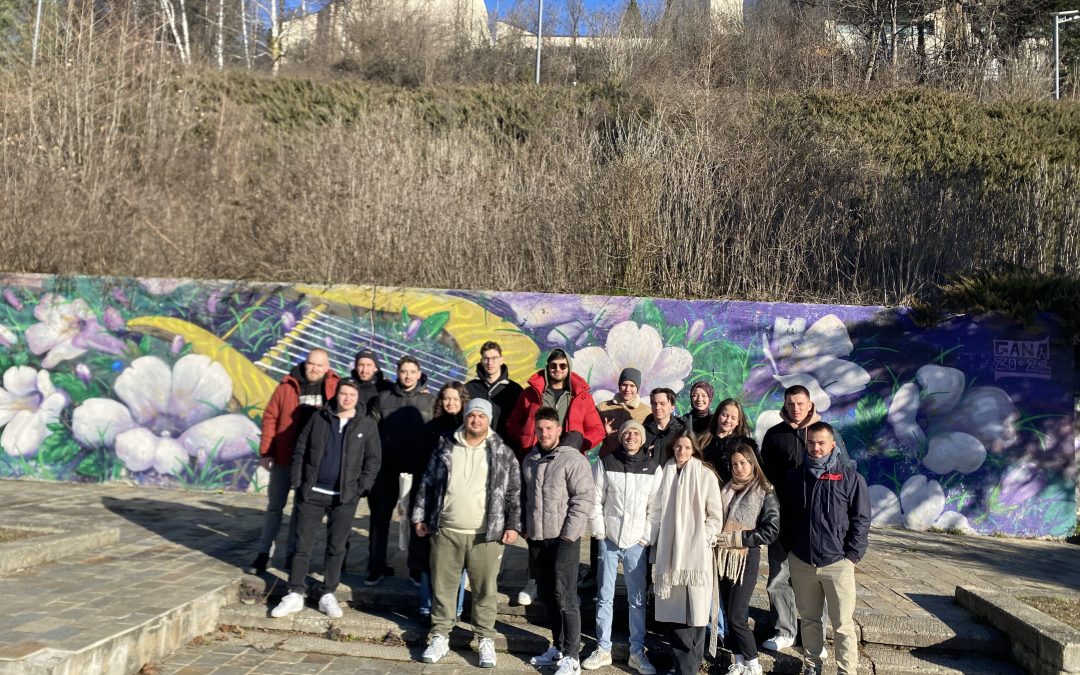
International youth mobility is also an opportunity to understand the place that hosts it.
For participants in “Sustainable Youth Action for Community Impact,” Smolyan was not simply the location written on a travel ticket.
The Rhodope Mountains became an important part of the learning experience.
During the youth exchange, participants from Bulgaria, Romania and Greece explored elements of local history, cultural heritage, traditions and identity.
One of the themes appearing in their city missions was the legendary connection between the Rhodopes and Orpheus and Eurydice.
For international participants, the legend opened a door to understanding how mythology, landscape and regional identity can become closely connected.
Other challenges encouraged young people to discover local cultural references, Rhodope words, stories, food traditions and significant places in Smolyan.
This cultural exploration served a wider educational purpose.
Intercultural learning is most powerful when participants move beyond presenting flags, traditional dishes and national stereotypes.
It requires curiosity about how people understand their own community and why certain places, stories and traditions are important to them.
The international composition of the exchange made comparison natural.
Young people from Bulgaria, Romania and Greece could identify similarities in Balkan traditions while also discovering important differences.
These conversations created opportunities to discuss identity without presenting cultures as fixed or isolated.
Instead, participants could see how regional, national and European identities coexist.
The connection with Erasmus+ was particularly meaningful.
A young person can be deeply connected to the Rhodope Mountains and simultaneously feel part of a wider European community.
European belonging does not require abandoning local identity. In many cases, international exchange helps participants appreciate their own local culture more deeply because they must explain it to someone seeing it for the first time.
The participant feedback from the exchange supports this dimension.
All three group leader reports confirmed that the mobility contributed to greater openness to European multiculturalism and a stronger European sense of belonging.
That combination is significant.
The exchange encouraged young people to discover Europe not as something distant from local communities, but as a space where different local identities can meet, communicate and learn from each other.
From Orpheus to Erasmus+, the activity showed that cultural heritage can be a bridge rather than a boundary.
And in the Rhodope Mountains, a European youth exchange became an opportunity both to look outward towards Europe and inward towards the stories and values that shape local communities.
Disclaimer: Funded by the European Union. Views and opinions expressed are, however, those of the author(s) only and do not necessarily reflect those of the European Union or the competent programme authorities. Neither the European Union nor the granting authority can be held responsible for them.