
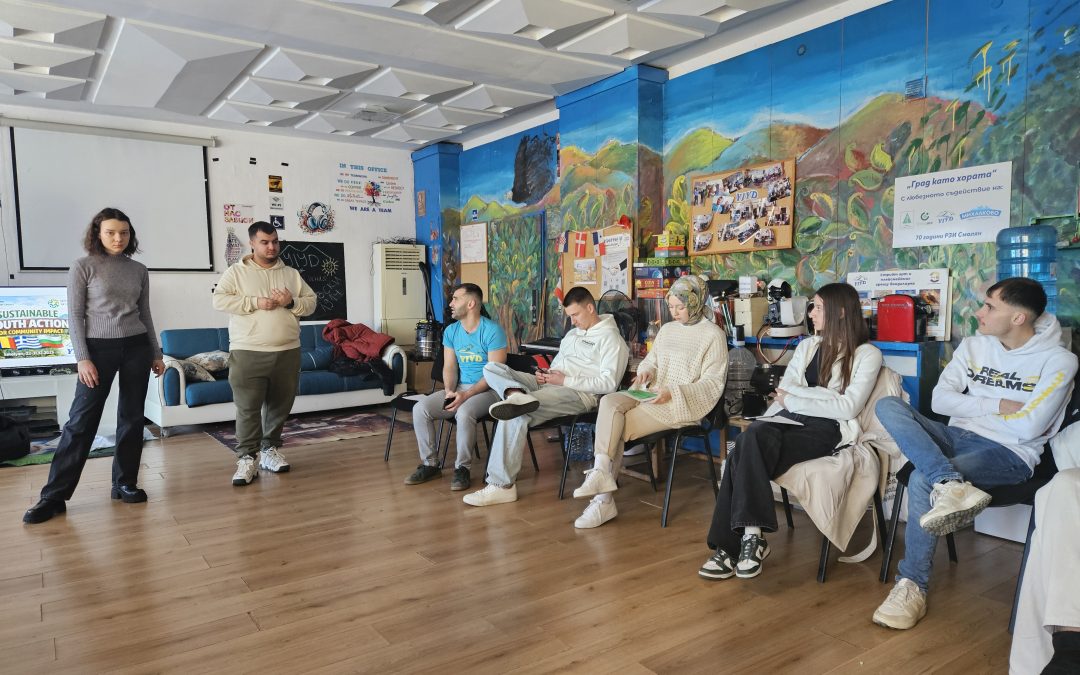
Today we went deeper into one of the main themes of our youth exchange: sustainability and responsible consumption.
Instead of starting with complicated definitions, we looked at our own everyday lives.
What do we buy?
How do we travel?
How much do we throw away?
How often do we choose convenience without thinking about its environmental impact?
Working in international groups helped us compare habits in Bulgaria, Romania and Greece.
Some practices were similar, while others were surprisingly different.
The important part was that nobody was expected to be “perfectly sustainable”.
The activities encouraged us to analyse our behaviour rather than judge each other.
Through discussions and practical group work, we explored the relationship between personal choices and larger environmental challenges.
One person changing a habit may seem insignificant.
But millions of people making the same decision can create a completely different impact.
Transport was another interesting part of the discussion.
Our own exchange gives a practical example: the project encouraged sustainable travel whenever possible. All 22 people involved in the Youth Exchange — 19 participants and three group leaders — were recorded as using sustainable means of transport.
That made the conversation much more real.
Sustainability was not something written only in the project description.
It influenced how we actually reached Smolyan.
We also discussed how young people can promote sustainable behaviour without sounding like they are constantly telling other people what they are doing wrong.
Our conclusion was simple: example is often stronger than preaching.
The day ended with another reflection session.
Many of us realised that environmental responsibility does not always require dramatic lifestyle changes.
Sometimes it starts with very ordinary decisions repeated every day.
Tomorrow we will connect these individual choices with another important question:
How can young people influence what happens in their communities?
Disclaimer: Funded by the European Union. Views and opinions expressed are, however, those of the author(s) only and do not necessarily reflect those of the European Union or the competent programme authorities. Neither the European Union nor the granting authority can be held responsible for them.