
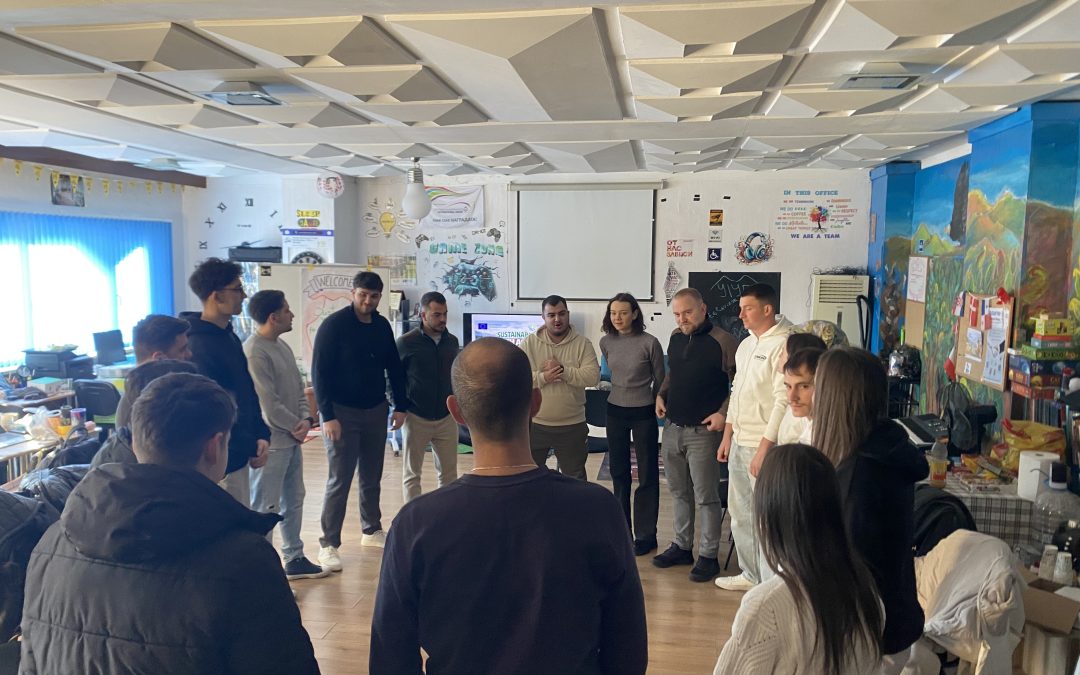
Today we moved from environmental responsibility to active citizenship and youth participation.
One of the most interesting discussions started with a simple question:
What does it actually mean to be an active citizen?
Voting was one of the first answers.
But very quickly our list became much longer.
Volunteering.
Expressing an opinion.
Organising an initiative.
Helping a neighbour.
Protecting the environment.
Speaking when something is unfair.
Participating in local decisions.
Creating something useful for other people.
We discussed democracy, equality, citizenship, human rights and the role young people can play in shaping their communities.
What made the conversation especially interesting was the international perspective.
Participants from Bulgaria, Romania and Greece compared how young people participate in their communities and what barriers often stop them.
Sometimes young people think institutions will not listen.
Sometimes they do not know where to start.
Sometimes they simply believe that somebody else should solve the problem.
Our activities challenged that mentality.
We worked with real examples and discussed how a local problem can become a youth-led initiative.
The goal was not to pretend that young people can solve every social issue alone.
The goal was to understand that participation starts when we stop seeing ourselves only as observers.
We also connected these conversations with European values.
Europe is not only institutions, programmes and borders.
It is also democracy, human dignity, equality, respect for diversity and participation.
For many of us, Erasmus+ makes these ideas easier to understand because we experience them directly.
We are sharing one space with people from different countries, cultures and backgrounds.
We have to listen.
Negotiate.
Respect different opinions.
And somehow still make decisions together.
In a small way, our international group is practising exactly the type of democratic cooperation we are discussing.
Tomorrow we will leave the training environment and take these ideas directly into the streets of Smolyan.
Disclaimer: Funded by the European Union. Views and opinions expressed are, however, those of the author(s) only and do not necessarily reflect those of the European Union or the competent programme authorities. Neither the European Union nor the granting authority can be held responsible for them.