
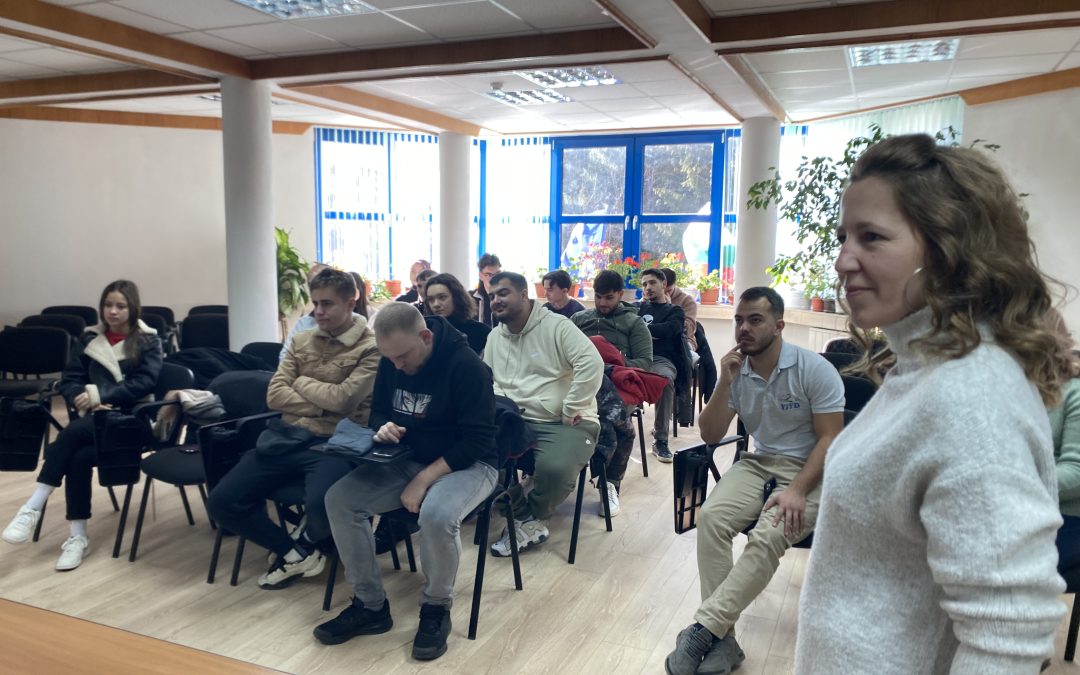
Environmental education becomes much more powerful when young people can connect learning with institutions responsible for protecting the environment in real life.
During the Erasmus+ Youth Exchange “Sustainable Youth Action for Community Impact,” participants had the opportunity to connect the project’s environmental dimension with the local institutional context through an educational visit to the Regional Inspectorate of Environment and Water – Smolyan (RIEW Smolyan).
The visit complemented the programme’s broader focus on sustainability, responsible behaviour and community action.
Throughout the exchange, participants discussed how individual choices influence the environment and how young citizens can contribute to sustainable communities.
The institutional visit added another perspective: environmental responsibility also depends on public systems, regulation, monitoring, expertise and cooperation between citizens and institutions.
For young people, this was an opportunity to understand environmental protection beyond social media campaigns or individual lifestyle decisions.
Environmental challenges require cooperation between citizens, civil society, municipalities, experts and public authorities.
The Rhodope region provides a particularly meaningful setting for such discussions.
Smolyan is surrounded by mountain ecosystems, forests and rich biodiversity. The relationship between local communities, tourism, natural resources and environmental protection is therefore visible in everyday life.
Participants could connect European discussions about sustainability with a concrete regional reality.
The visit also demonstrated an important principle of quality youth work: local stakeholders can become educational partners.
International mobility does not need to remain isolated inside a hotel or training venue.
By connecting participants with local institutions, organisations and community actors, the programme becomes more relevant and provides a more realistic understanding of how change happens.
For the Bulgarian participants, the visit increased awareness of an institution operating in their own region.
For the Romanian and Greek participants, it offered an opportunity to compare how environmental responsibilities and local ecological challenges are addressed in another European country.
The activity supported the wider objectives of the youth exchange: developing critical thinking, environmental responsibility, European awareness and a stronger connection between learning and community life.
The project therefore approached sustainability from several directions: educational content, sustainable travel, responsible consumption, community observation and institutional learning.
Together, these elements strengthened the message that environmental responsibility is not a single workshop topic.
It is a shared process involving behaviour, knowledge, institutions and active citizenship.
Disclaimer: Funded by the European Union. Views and opinions expressed are, however, those of the author(s) only and do not necessarily reflect those of the European Union or the competent programme authorities. Neither the European Union nor the granting authority can be held responsible for them.