
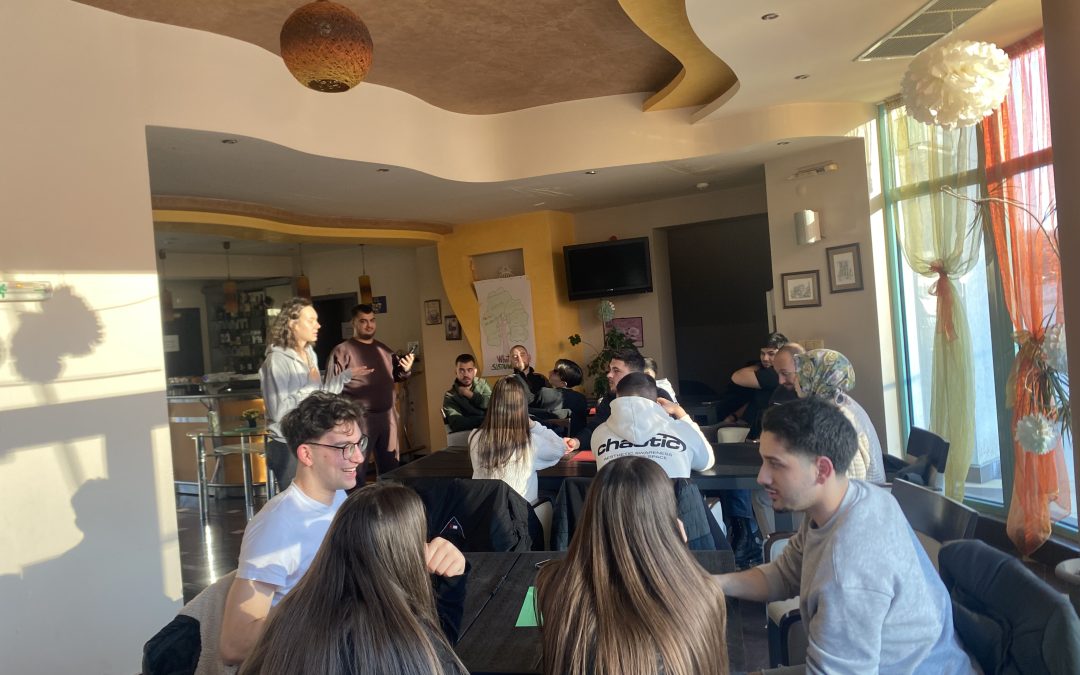
Sustainability was not treated as a slogan during the Erasmus+ Youth Exchange “Sustainable Youth Action for Community Impact.”
It became a question participants were encouraged to ask throughout the programme: What can I actually change in my everyday life and in my community?
The international youth exchange took place in Smolyan, Bulgaria, from 22 to 31 December 2025, bringing together young people from Bulgaria, Romania and Greece within Erasmus+ project 2025-1-BG01-KA151-YOU-000298009.
The programme explored environmental responsibility, responsible consumption, local community development and the relationship between individual behaviour and wider social change.
Rather than simply discussing climate change through presentations, the young people worked through practical exercises, international teamwork and observation of the local environment.
Participants analysed how everyday decisions involving transport, consumption, waste, resources and lifestyle can influence the environment. They also discussed the responsibility of communities and institutions and explored how young citizens can contribute to change without waiting for someone else to act first.
The organisation of the mobility itself also reflected the sustainability principle.
All 22 persons involved in the Youth Exchange – 19 participants and three group leaders – were recorded as using sustainable means of transport. This exceeded the initial project target for green travel.
This was an important practical message: environmental responsibility should be visible not only in what a project teaches, but also in how the project is organised.
Smolyan and the Rhodope Mountains provided a particularly relevant environment for these discussions. The region is closely connected with forests, biodiversity, mountain landscapes and local communities whose development depends on maintaining a sustainable relationship with natural resources.
Participants were encouraged to observe this relationship and consider what sustainability means in different national and local contexts.
The Bulgarian, Romanian and Greek groups brought different experiences to the discussion. Some participants came from smaller communities, while others had different experiences of environmental initiatives, volunteering and youth participation.
The exchange therefore became a platform for comparing approaches rather than promoting a single model.
Participants did not leave the activity with one universal answer to environmental challenges. Instead, they developed a stronger ability to ask questions, analyse their own behaviour, communicate ideas and cooperate with other young people.
This is one of the strongest contributions of non-formal education: it creates space where knowledge can become reflection, and reflection can become action.
“Sustainable Youth Action for Community Impact” showed that sustainability becomes meaningful when young people are not only told what responsible behaviour means, but are trusted to discuss, experiment, challenge assumptions and develop their own ideas.
Disclaimer: Funded by the European Union. Views and opinions expressed are, however, those of the author(s) only and do not necessarily reflect those of the European Union or the competent programme authorities. Neither the European Union nor the granting authority can be held responsible for them.