
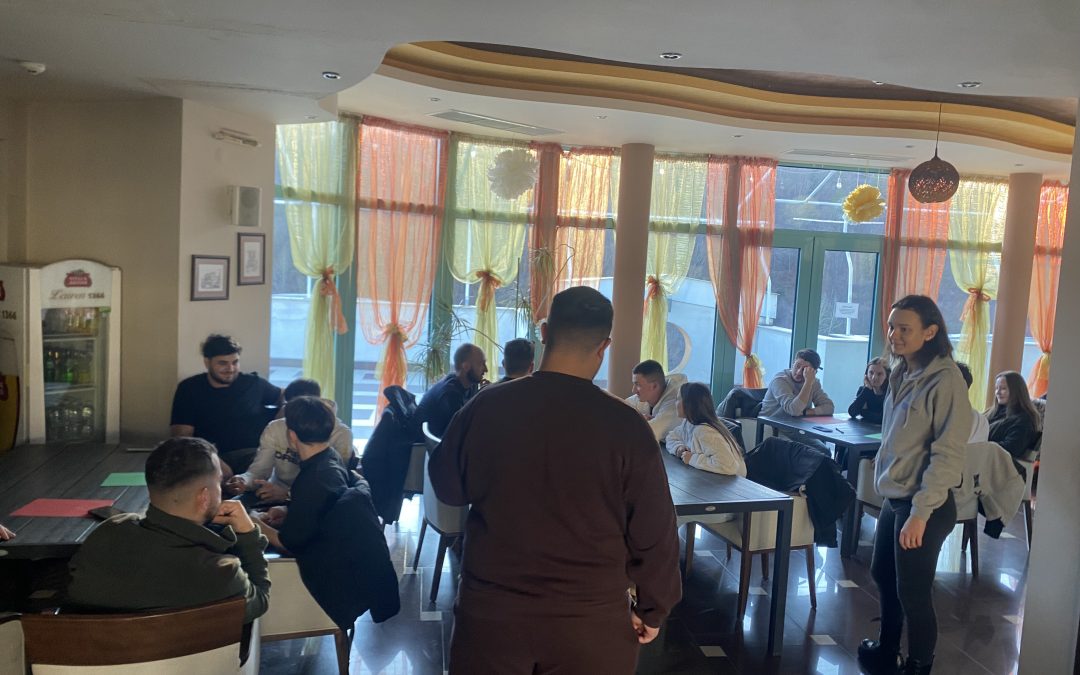
No desks in rows. No traditional exams. No teacher providing every answer.
Instead: international teamwork, challenges, discussion, reflection, creativity and learning through experience.
This was the educational approach behind “Sustainable Youth Action for Community Impact,” the Erasmus+ Youth Exchange held in Smolyan from 22 to 31 December 2025.
Non-formal education was not simply one method used during the project. It was the foundation of the programme.
Participants from Bulgaria, Romania and Greece were expected to become active creators of the learning process.
Activities included small-group work, practical missions, intercultural exchange, community exploration, creative tasks, discussions and structured reflection.
This approach allowed participants with different levels of experience to contribute.
Previous Erasmus+ participation was not necessary.
Perfect English was not necessary.
What mattered was motivation, willingness to communicate and readiness to participate.
Working in international teams was itself an educational experience.
Participants had to distribute responsibilities, explain ideas, manage different opinions and find common solutions.
Sometimes this process was more important than the final answer to the task.
Reflection helped participants recognise that learning.
At different points during the programme, the young people were encouraged to think about what they had discovered, which skills they were developing and how their attitudes were changing.
This supported the later Youthpass process and helped transform individual activities into an understandable learning journey.
Official participant feedback confirmed the strength of the educational methodology.
All three group leader reports gave positive assessments of the quality of non-formal education methods used during the youth exchange.
The reports also identified positive results in teamwork, adaptation to new situations, collaboration with people from different cultures, tolerance, critical thinking and active citizenship.
These are exactly the kinds of competences that are difficult to develop through passive learning alone.
Non-formal education creates room for young people to test themselves.
A participant who may remain silent during a lecture might become highly active during a team challenge.
Someone uncomfortable speaking in front of a large group may contribute strongly through photography, research or practical problem solving.
A young person with little international experience may discover that they can communicate and cooperate successfully with people from other countries.
That experience builds confidence in ways that cannot always be measured immediately.
For Young Improvers for Youth Development, non-formal education remains one of the strongest tools for creating meaningful international learning experiences.
The success of “Sustainable Youth Action for Community Impact” demonstrated once again that young people learn exceptionally well when they are trusted to participate actively in their own learning.
Disclaimer: Funded by the European Union. Views and opinions expressed are, however, those of the author(s) only and do not necessarily reflect those of the European Union or the competent programme authorities. Neither the European Union nor the granting authority can be held responsible for them.