
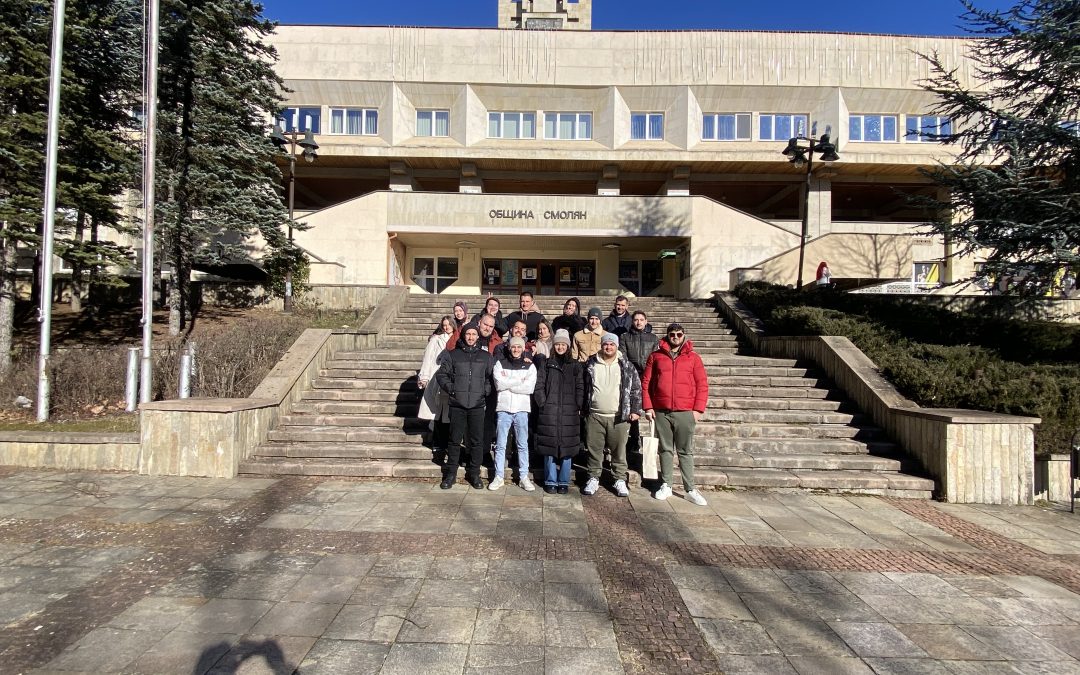
What happens when a city becomes a classroom?
During the Erasmus+ Youth Exchange “Sustainable Youth Action for Community Impact”, participants from Bulgaria, Romania and Greece left the traditional training environment and explored Smolyan through an interactive community challenge.
Working in small international teams, the young people took part in a city-based mission combining elements of a treasure hunt, PhotoVoice, local research, cultural discovery and active citizenship.
The objective was not simply to find landmarks.
Participants had to observe, ask questions, communicate with local residents, document their discoveries and reflect on what makes a community strong.
The missions connected several dimensions of Smolyan.
Some tasks invited participants to explore local cultural identity and the heritage of the Rhodope Mountains. Others required them to speak with local people and collect opinions about the city, youth opportunities, community challenges and European programmes.
Photography became another learning tool.
Instead of taking pictures only as tourists, young people were encouraged to document elements of the city that represented strengths, challenges, traditions or possibilities for improvement.
This approach reflects the logic of PhotoVoice: using images to observe a community and stimulate discussion about what people value and what they would like to change.
The activity also challenged participants to communicate outside their international group.
Speaking with local residents required confidence, curiosity and creativity, especially when language differences appeared.
For some young people this meant stepping outside their comfort zone. For others it was an opportunity to discover that communication does not depend only on perfect language skills.
The city challenge also supported active citizenship.
Participants were encouraged to think critically about their surroundings rather than simply consume the city as visitors. What spaces are important for young people? Where can young citizens participate? What makes people feel connected to their community? What could be improved?
These questions turned a walk through Smolyan into a practical civic learning experience.
The activity reflected one of the central principles of Erasmus+: learning does not happen only through formal instruction.
Learning can happen while solving a challenge, interviewing a stranger, navigating a new city, working with someone from another country or discovering that a familiar social problem looks different from another cultural perspective.
By the end of the activity, Smolyan was no longer simply the host city of the exchange.
It had become part of the educational methodology itself.
The experience demonstrated how relatively simple non-formal education methods can combine cultural discovery, teamwork, media skills, civic awareness and intercultural learning in one activity.
Disclaimer: Funded by the European Union. Views and opinions expressed are, however, those of the author(s) only and do not necessarily reflect those of the European Union or the competent programme authorities. Neither the European Union nor the granting authority can be held responsible for them.